The Architectural Guide to Solid Brass Door Knockers for Teak & Wooden Main Doors
A definitive technical specification on timber mechanics, binary CuZn40 metallurgy, through-bolt tensile anchoring, acoustic resonance modeling, and South Indian regional climate durability for luxury villa portals.
- 01. The Entrance Threshold as an Architectural Declaration
- 02. Anatomy of Teak Wood & Door Thickness Standards
- 03. Sand-Cast Metallurgy: Binary CuZn40 vs Hollow Pot Metal
- 04. Acoustic Resonance Physics vs Electronic Buzzers
- 05. Through-Bolt Mounting Engineering & Anti-Pry Mechanics
- 06. Regional South Indian Luxury Residences: Climate Dynamics
- 07. Symbolic Heritage & Sacred Motif Selection
- 08. Living Patina Evolution & Conservation Chemistry
- 09. Architectural Specification Matrix & Trade Concierge
The Entrance Threshold as an Architectural Declaration
In classical Indian spatial theory and contemporary tropical residential design, the entrance threshold—the Dehliz of northern courtyard havelis, the Ummarappadi of Dravidian and Malabar domestic architecture—is never treated as an incidental partition. It is an intentional boundary condition. It orchestrates the transition from the kinetic, unfiltered exterior environment to the tranquil, sanctified sanctuary of private domestic life. To cross this line is an act of arrival; to knock upon it is a physical declaration of intent.
Yet, in modern luxury estate construction across Bengaluru, Hyderabad, Chennai, and Kochi, an unfortunate aesthetic dissonance frequently manifests at this exact junction. Private residences commissioned with multi-crore architectural budgets frequently specify magnificent 8-foot to 10-foot custom door portals, crafted from seasoned Burma teak, aged Nilambur timber, or dense Honne wood costing upwards of ₹3,00,000 to ₹7,00,000 per leaf. However, when specifying the door knocker—the singular element that every arriving resident and distinguished guest must physically touch, lift, and release—the hardware schedule is too often surrendered to hollow, stamped pot metal, zinc alloy die-castings, or thin electroplated synthetics sourced from generic hardware distributors.
The human hand perceives weight, density, thermal conductivity, and structural authenticity instantaneously. A hollow fitting communicates fragility and superficiality before the door has even swung open. Conversely, an unfilled, heavy solid metal casting delivers a profound sense of permanence, cold metallic ballast, and structural authority. Indistores was established on this architectural principle: reviving monolithic, sand-cast Solid Brass hardware engineered specifically to honor the physical mass, resonant acoustics, and structural gravitas of South Indian seasoned hardwood doors.
Anatomy of Teak Wood & Door Thickness Standards (35mm to 55mm+)
To engineer a hardware mounting system that endures for generations, an architect must first understand the organic anatomy and mechanical behavior of the host timber. Teak (Tectona grandis) remains the unquestioned sovereign of Indian architectural hardwoods, prized for centuries in royal portals, temple chariots, and colonial estates.
The Hardwood Spectrum: Burma, Nilambur, and CP Teak
Not all teak exhibits identical physical properties. Their cellular structure and density govern how vibration travels and how fasteners maintain thread tension:
Burma Teak (Old-Growth Timber): Noted for exceptionally tight annual growth rings (often 12–18 rings per inch), high natural silica content, and a rich saturation of natural tectoquinone oils. With a seasoned oven-dry density ranging between 650 kg/m³ and 720 kg/m³, it offers near-impervious defense against tropical wood-boring insects and fungal decay. Its oily nature imparts natural lubricity around drilled boreholes, preventing fastener seizure while damping high-frequency acoustic chatter.
Nilambur & Malabar Teak: Harvested from the historic plantation valleys of Kerala, this timber exhibits magnificent golden-amber to deep hazelnut hues with pronounced dark figuring. Its cellular structure is marginally more elastic than Burmese heartwood, providing supreme resilience against continuous wet-season hygroscopic swelling.
Central Province (CP) Teak & Honne (Pterocarpus marsupium): Commonly specified across Karnataka and Telangana villas. Honne, while technically not true teak, matches seasoned teak in hardness and structural shear resistance, featuring an interlocking fibrous grain that provides formidable bite for through-bolt anchoring assemblies.
Door Thickness Classifications & Structural Applications
Engineering Standard- 35mm (1.38 inches) • Standard Luxury Apartment Doors: Found primarily in high-end multi-family residential developments (e.g. Indiranagar penthouses or Financial District high-rises). Typically features a solid hardwood core with matched vertical grain face veneers. Best suited for balanced hardware weighing between 600g and 1,200g, such as the Nandi Majesty Knocker.
- 40mm to 45mm (1.57 to 1.77 inches) • Bespoke Single-Leaf Villa Portals: The gold standard for private residential villas across Sadashivanagar and Jubilee Hills. Constructed with solid stile-and-rail timber joinery and thick floating fielded panels. Demands 800g to 2.5kg solid brass ballast with through-bolt M6 machine anchoring.
- 50mm to 55mm+ (2.0 to 2.5+ inches) • Monumental Double Portals & Pivot Gates: Palatial entrance doors for sprawling suburban estates, coastal retreat gates on East Coast Road, and traditional heritage restorations. Slabs of this scale weigh between 90kg and 180kg per leaf. They require monumental architectural hardware—such as the 3.0 kg Lion King Large Knocker—anchored via heavy M8 through-bolts to maintain visual balance and mechanical authority.
Stile Anatomy and Hygroscopic Movement
In traditional five-panel or four-panel stile-and-rail wooden doors, the door knocker must strictly be positioned along the vertical hanging stile (minimum width 125mm to 160mm) or upon the solid lock-rail. It should never be mounted directly onto the thinner floating central field panels. Floating panels are engineered to expand and contract freely within internal frame grooves; anchoring heavy hardware into them inhibits natural timber respiration and risks panel splitting.
In peninsular South India, relative humidity oscillates dramatically between 25% during peak dry summer and 95% during the monsoon. Over an annual cycle, a 45mm solid teak door slab undergoes tangential cross-grain dimensional flux of 1.2% to 2.5%. Fasteners that rely purely on shallow wood-screw threads inevitably work loose as the timber cells compress and expand around the steel threads. Through-bolt mounting, by contrast, sandwiches the timber in compression across its transverse axis, completely isolating the assembly from seasonal hygroscopic creep.
Sand-Cast Metallurgy: Binary CuZn40 Alloy vs Hollow Pot Metal
The term “brass” is frequently misused in commercial hardware catalogues as a cosmetic descriptor rather than a metallurgical standard. A steel plate electroplated with a 5-micron brass flash is marketed alongside hollow die-cast zinc alloys coated in yellow polyurethane. For true architectural specification, material purity must be defined by chemistry, crystalline grain morphology, and manufacturing method.
“True luxury is never light. Authentic solid brass is an unfilled, monolithic physical mass—a binary alloy that rings like an ancient cathedral bell and welcomes the patina of passing generations.”
— Indistores Foundry Metallurgical Dossier, Standard IS 319 / CuZn40The Crystalline Structure of Sand-Cast Solid Brass
Authentic architectural hardware produced by Indistores is cast from high-grade virgin metallurgical brass, specifically a binary alloy conforming to the CuZn40 matrix (approximately 60% to 65% copper and 35% to 40% zinc, with controlled trace grain refiners). At an atomic level, this binary alpha-beta brass alloy delivers:
Volumetric Density: Solid brass possesses an authentic density of 8.45 to 8.65 g/cm³. By comparison, zamak (zinc alloy) registers ~6.7 g/cm³, and hollow aluminium barely reaches 2.7 g/cm³. When an architect lifts an authentic Sand-Cast Solid Brass knocker, its substantial mass is immediately palpable. It is an Unfilled Solid Metal Casting—there are no hollow inner pockets filled with lead scrap, plaster, or synthetic resins.
Isotropic Grain Structure: High-pressure die-castings force molten metal into cold steel dies within milliseconds, causing extreme thermal shock, directional grain slippage, and microscopic internal gas porosity. Under cyclic mechanical strikes, these internal micro-fractures propagate, leading to catastrophic brittle failure where the knocker ring snaps at the hinge lug. In contrast, sand casting pours molten brass at 980°C to 1,020°C into refractory silica-sand moulds bonded with natural clay. The casting cools slowly and naturally over hours. This thermal equilibrium promotes uniform, isotropic equiaxed crystal growth across all dimensions, giving the finished casting immense tensile strength (340 to 450 MPa) and extraordinary fracture toughness under relentless cyclic kinetic shock.
The Inherent Failure of Lacquered and Electroplated Synthetics
Many commercial hardware manufacturers coat cheap polished brass in glossy polyurethane lacquer to prevent tarnishing in transit. In tropical climates, this practice is catastrophic. Atmospheric moisture penetrates microscopic pores and scratches in the clear coat. The underlying metal begins to oxidize, but the trapped water vapor forms dark, cloudy brown bloom and greenish pustules beneath the plastic film. Because the lacquer prevents uniform oxidation, the surface appears leprous and flaking. Stripping failed synthetic lacquer requires harsh toxic chemical baths that often ruin the adjacent door finish.
Indistores architectural knockers are supplied in raw, unlacquered Heirloom Solid Brass. The alloy is left uninhibited to breathe and interact organically with its environment. Over months and years, it forms an ultra-thin, passivating cuprite (Cu2O) oxide layer that chemically seals the surface against deep atmospheric degradation. High-relief contact surfaces touched daily remain brightly burnished by the natural friction of human skin, while the sheltered recesses deepen into rich, smoldering umber and antique bronze contours. It is a living patina that cannot be replicated by artificial spray paints.
Acoustic Resonance Physics vs Electronic Buzzers
The transition from mechanical door knockers to modern piezoelectric doorbells and video intercoms represents a subtle yet profound sensory degradation in residential architecture. An 85-decibel electronic buzzer produces an abrasive, synthetic square-wave frequency designed to startle rather than announce. It intrudes abruptly into domestic calm and induces mild cognitive alarm.
A mechanical door strike, by contrast, is a harmonically complex acoustic event governed by classical wave mechanics and physical material resonance. When an Indistores solid brass striker drops against its dedicated brass strike stud, it couples mechanical kinetic energy directly into the dense timber resonator of the door slab.
Acoustic Spectral Analysis: The Tri-Harmonic Resonance Envelope
Acoustic Physics- Low-End Cavity Resonance (48Hz to 120Hz) • The Sovereign “Thud”: As the kinetic energy of the brass mass transfers into the door slab, the massive timber volume vibrates as an acoustic diaphragm. This generates a low-frequency, omnidirectional pressure wave that travels effortlessly through solid masonry, concrete framing, and long corridors, felt as much as heard.
- Strike Transient Attack (800Hz) • The Crisp Articulation: The momentary contact between the solid brass striker ring and the brass anvil generates a crisp, high-definition initial transient spike. This frequency cuts cleanly through household ambient sound (air conditioning hum, kitchen bustle, courtyard fountains) without requiring excessive decibel volume.
- High-Order Crystalline Decay (280Hz, 640Hz, 1280Hz) • The Chime of Brass: Because the knocker is an uninhibited casting of dense binary brass, the striker ring itself acts as a bell. It emits a musical decay envelope featuring a 280Hz fundamental tone supported by harmonic overtones at 640Hz and 1280Hz, sustaining gently for 1.8 to 2.4 seconds after impact.
Acoustic velocity through seasoned teak timber averages 3,900 to 4,200 meters per second—more than twelve times faster than sound transmission through open air (343 m/s). Consequently, the entire entrance portal functions as a high-fidelity acoustic amplifier. The sound is natural, warm, authoritative, and dignified. It communicates presence with respect, reviving the sacred classical ethos of Atithi Devo Bhava—the guest as an honored arrival rather than a digitized push notification.
Through-Bolt Mounting Engineering vs Surface Screws
A hardware specification is only as robust as its mechanical fastening methodology. High-traffic estate entrances subject a knocker to thousands of dynamic impact cycles per year. A knocker weighing between 800g and 3.0kg accelerates under hand force, creating significant instantaneous shear stress and pull-out torque at the anchor points.
The Mechanical Inadequacy of Surface Wood Screws
Standard commercial knockers are frequently supplied with decorative 25mm to 35mm brass-plated wood screws intended for surface installation. In architectural hardwoods, this represents a severe mechanical vulnerability:
1. Limited Thread Shear Area: A surface screw relies exclusively on the shallow engagement of its threads against localized timber wood grain fibers. Under repeated outward pulling and downward striking impacts, these tiny timber ridges experience cyclic micro-crushing.
2. Hygroscopic Grain Softening: During the heavy monsoon months across South India, ambient timber moisture content climbs from 10% to over 20%. Moistened wood fibers lose up to 35% of their tensile holding power. The screws loosen, the knocker tilts off-axis, and the sharp screw threads gouge irreversible enlarged holes into the door face.
3. Vulnerability to Tampering: Exterior surface screws can be removed within seconds using a common hand screwdriver, compromising estate perimeter security.
The Indistores Through-Bolt Engineering Standard
To ensure permanent, generational stability, Indistores mandates a through-bolt mechanical sandwich across all installations. This specification comprises four harmonized components:
1. Blind Threaded Bosses: The reverse side of each Indistores knocker features solid brass mounting bosses tapped with precision machine threads (M6 metric thread for residential knockers up to 1.5kg; heavy M8 metric thread for monumental pieces exceeding 2.0kg). Crucially, these holes do not pierce the front artistic face, maintaining an unbroken sculptural surface with zero exposed screw heads.
2. High-Tensile Brass Threaded Rods: Solid brass studs are threaded into the knocker bosses with medium-strength anaerobic threadlocker (e.g. Loctite 243). The studs extend cleanly through precision-drilled boreholes running perpendicularly through the entire door thickness (35mm to 55mm+).
3. Large-Diameter Brass Load-Spreading Washers: On the interior door face, each rod receives a heavy solid brass washer with a minimum outer diameter of 25mm to 32mm and a thickness of 2.5mm. This spreads the mechanical clamping force across a broad surface area, preventing the interior timber grain from compressing or indenting under high torque.
4. Polished Interior Dome Acorn Cap Nuts: The assembly is secured with solid brass blind acorn dome nuts, polished to match the interior architectural hardware. The rounded dome eliminates sharp edges, preventing snags on clothing and creating an elegant, jewel-like finish on the interior face of the door.
Anti-Pry & High-Security Mechanical Profile
Security EngineeringBecause the fasteners are tightened exclusively from inside the residence, there is zero hardware access from the exterior porch. A trespasser cannot unscrew, lever, or pry the knocker from the door without destroying the structural timber stile itself. The assembly effectively acts as a solid metal clamp reinforcing the structural core of the door.
Regional South Indian Luxury Residences: Climate Dynamics
South India encompasses diverse microclimates, each exerting distinct thermal, chemical, and atmospheric demands on architectural door hardware. When specifying solid brass door knockers for luxury villas and private estates, architects must calibrate their material selections to regional atmospheric conditions.
| Region & Architectural Typology | Microclimate & Atmospheric Challenges | Recommended Motif & Mass | Fastener Engineering Spec |
|---|---|---|---|
| Bengaluru Modernist Villas Sadashivanagar, Indiranagar, Lavelle Road, Whitefield |
Highland plateau elevation (920m); intense South-West monsoon humidity followed by crisp dry winter air. High seasonal timber expansion flux. | Nandi Majesty Knocker (800g) Clean sculptural contours harmonizing with exposed form-finish concrete and raw Burma teak. |
M6 × 60mm Solid Brass Studs + 25mm Washers with blind acorn dome nuts. Accommodates 40mm–45mm doors. |
| Hyderabad Palatial Portals Jubilee Hills, Banjara Hills, Gandipet Mansions |
Extreme semi-arid summer heat (42°C–45°C) transitioning to torrential monsoon downpours. Severe thermal expansion stress on heavy pivot doors. | Lion King Large Knocker (3.0 kg) Monumental visual scale for grand 8ft to 10ft double doors requiring strong architectural ballast. |
M8 × 85mm High-Tensile Brass Through-Bolts + 32mm Heavy Washers. Engineered for 50mm–55mm+ slabs. |
| Chennai Coromandel Coast Boat Club, Poes Garden, ECR Seaside Estates |
Intense maritime salinity, persistent 75%–90% relative humidity, airborne chlorides. Plated hardware corrodes within months. | Sand-Cast Solid Brass (All Motifs) Forms an impervious self-protecting cuprite patina that thrives in marine atmospheres without flaking. |
M6 or M8 Solid Brass Machine Studs with silicone sealing washer beneath interior brass plate to prevent coastal moisture ingress. |
| Kochi & Malabar Heritage Tharavadu Panampilly Nagar, Fort Kochi, Backwater Estates |
Tropical coastal monsoon; extreme rainfall (>3,000mm annually); continuous dampness. Heavy organic timber tannins in Nilambur teak. | Peacock or Nandi Knocker Deep chased relief detailing; unlacquered brass forms rich antique patina complementing traditional woodwork. |
Passivated Solid Brass Fasteners; zero ferrous components to eliminate galvanic corrosion and timber tannin bleeding. |
Architectural Context: From Geoffrey Bawa to Deccani Grandeur
In Bengaluru, where contemporary residential architecture heavily reflects Sri Lankan tropical modernism and Geoffrey Bawa’s seamless integration of nature, entrance doors feature minimal moldings, wide teak stiles, and raw granite thresholds. The Nandi Majesty Knocker provides an organic, contemplative punctuation mark against these austere materials.
In Hyderabad’s grand estates across Jubilee Hills, architecture leans toward monumental scale, featuring soaring Deccani archways and imposing double doors. Here, a standard residential knocker would look lost and diminutive. The Lion King Large Knocker—measuring a commanding 33cm in height with a 10cm bold projection and weighing 3.0 kg—anchors the portal with unquestioned aristocratic majesty.
Along the Coromandel Coast of Chennai and the seaside villas of East Coast Road (ECR), sea breeze carries high concentrations of airborne sodium chloride. Ordinary hardware with zinc or iron cores suffers galvanic blistering and pitting. Solid brass contains no iron; its copper base forms a stable protective chemical barrier in the presence of chlorides, ensuring that the hardware remains structurally flawless for decades.
Symbolic Heritage & Sacred Motif Selection
In traditional Indian architectural treatises (Vastu Vidya and Manasara Shilpa Shastra), the threshold of the home is under the direct custody of the Dwarapalakas—symbolic guardians charged with welcoming positive universal energy (prana) while deflecting discord. The door knocker is the physical embodiment of this guardianship.
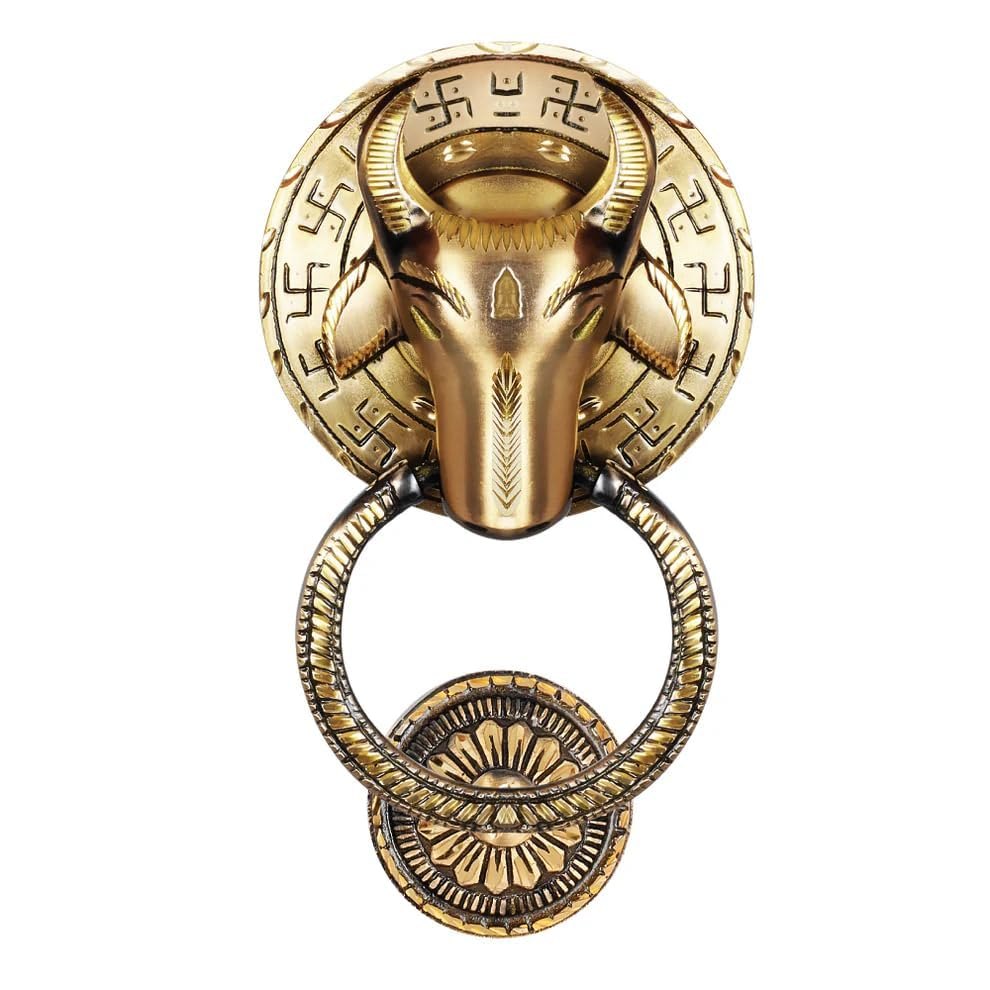
Nandi Majesty Door Knocker
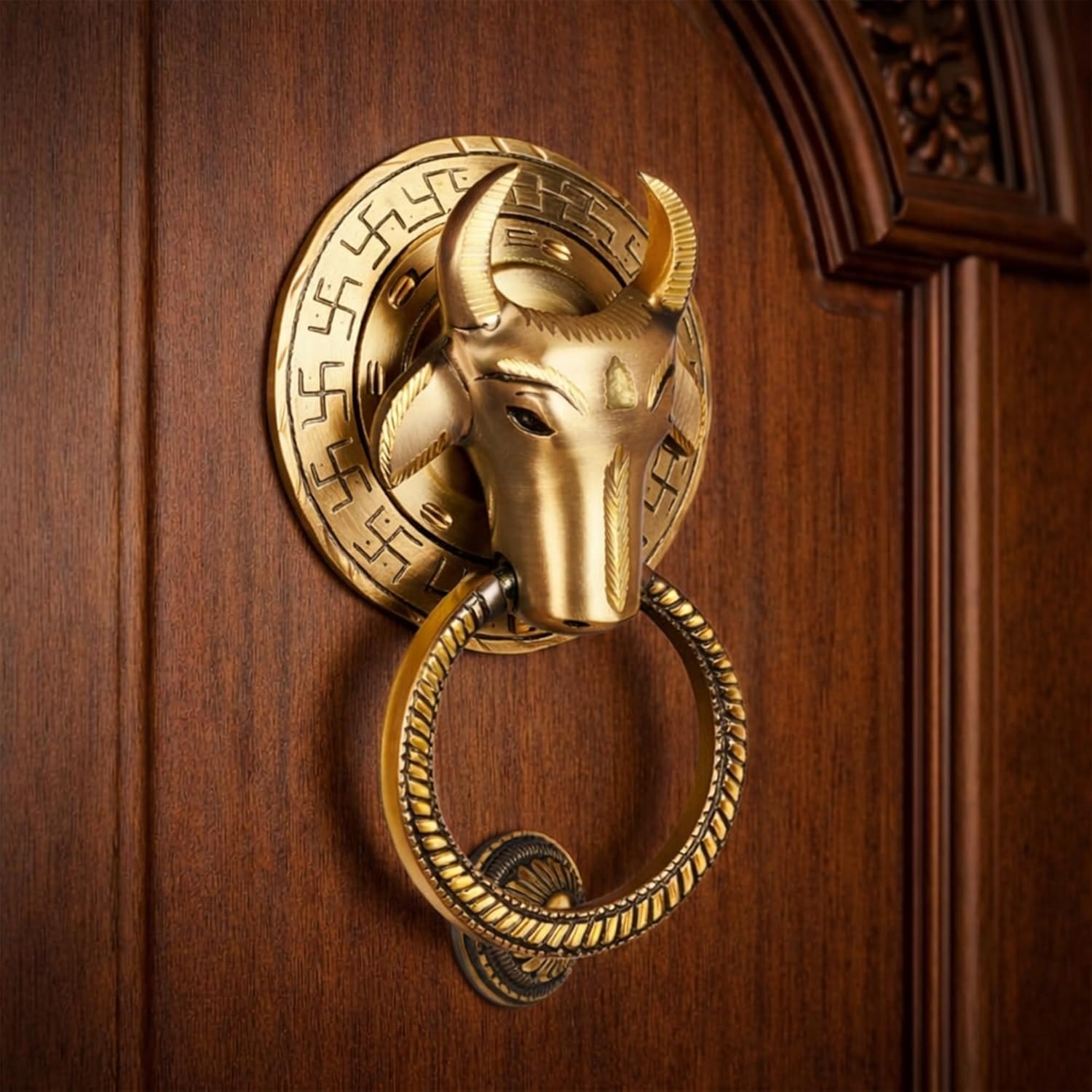
Sacred bull motif featuring hand-chased relief, fluted horns, and an integral floral strike anvil plate. The quintessential threshold guardian for private residences.
View Architectural Specifications →The Four Sovereign Motifs
1. Nandi (The Sacred Bull • Steadfast Patience & Truth): As the divine mount and foremost disciple of Lord Shiva, Nandi represents calm inner power, unwavering focus, and absolute sensory restraint. Placed upon the main portal, Nandi signifies that the residence within is a sanctuary of peace, ethical living, and steady generational prosperity. Ideal for single main doors, courtyard entrances, and homes designed for meditative serenity.
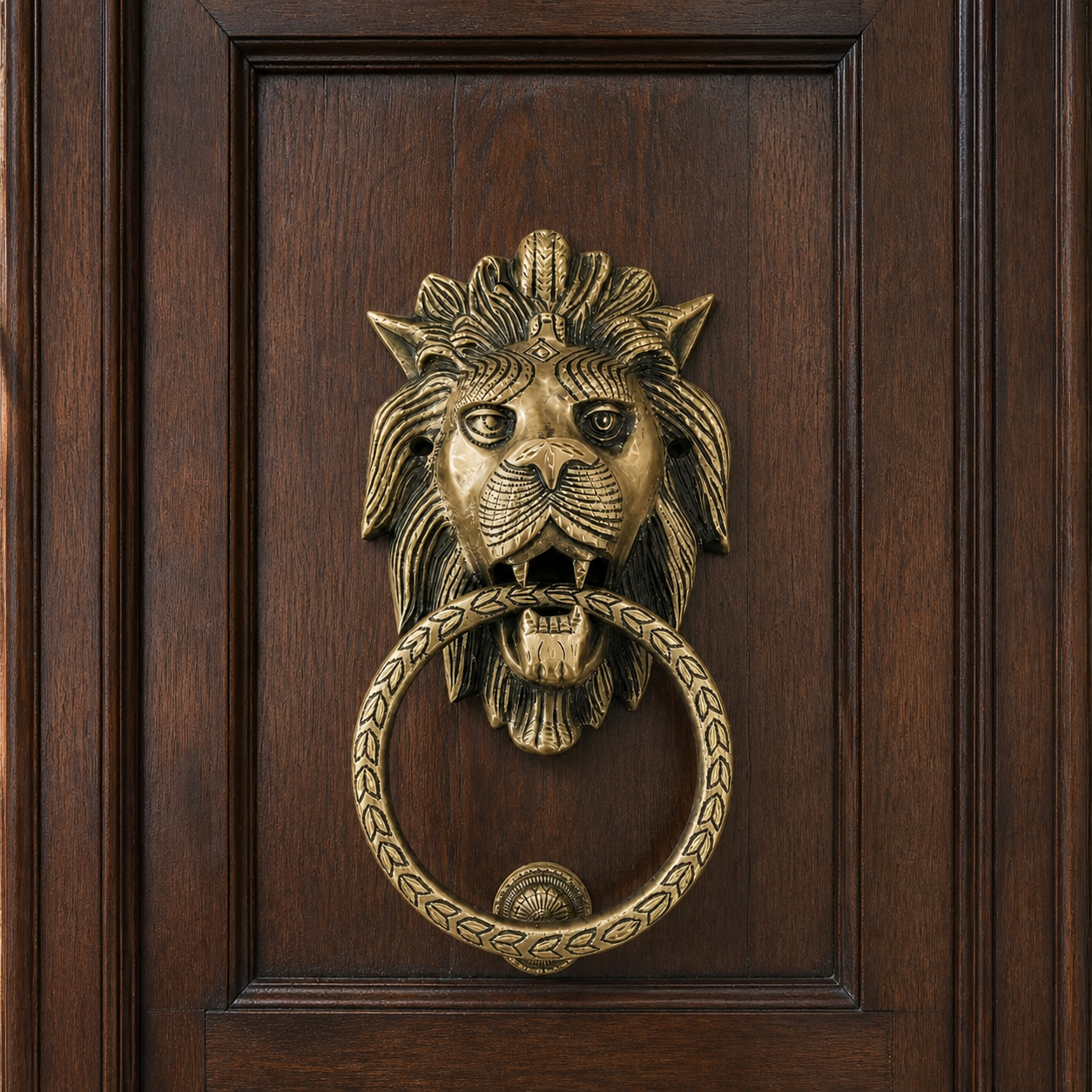
2. Lion King (Simha • Royal Sovereignty & Vigilant Valor): The lion is the universal emblem of royalty, fearless courage, and supreme protective authority. In Indian temple iconography, the Yali and Simha-mukha crown entrance lintels to ward off adversity. Placed upon monumental double-leaf teak portals, the lion knocker commands absolute respect and marks the home as an enduring family seat.
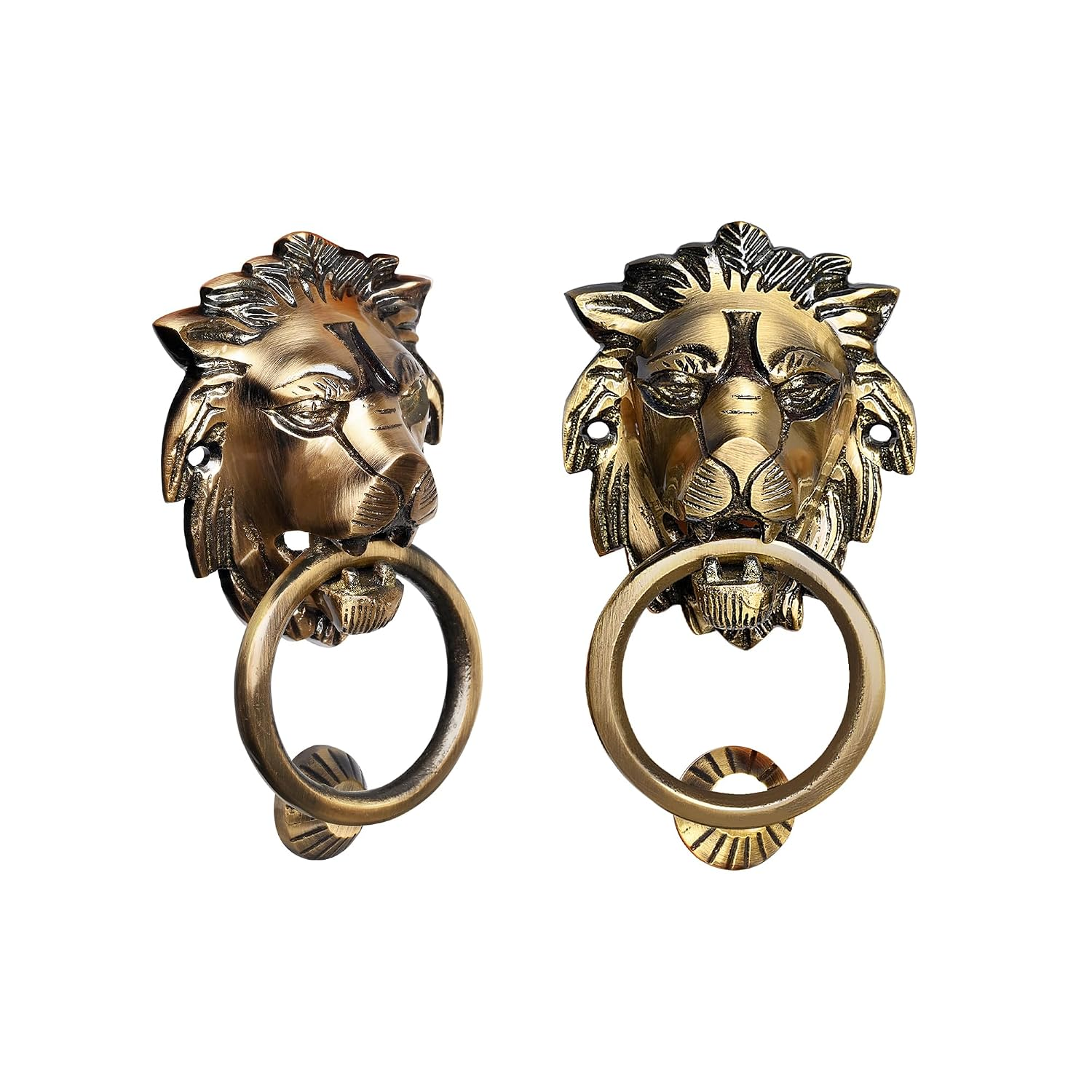
Lion King Large Door Knocker
Palatial 33cm sand-cast solid brass knocker featuring a high-relief lion mane and heavy laurel-wreath striker ring. Designed for monumental villa portals and estate gates.
View Architectural Specifications →3. Ganesha (Vighnaharta • Auspicious Beginnings & Wisdom): Lord Ganesha is traditionally invoked at the commencement of all sacred endeavors and at the threshold of newly consecrated homes (Griha Pravesh). The knocker incorporates the curved trunk, lotus pedestal, and benevolent gaze, blessing all who cross the threshold with wisdom, auspicious fortune, and obstacle-free endeavor.
4. Peacock (Mayura • Celestial Grace & Sanctuary Welcome): Closely associated with the grand havelis of Rajasthan and the palatial mansions of Chettinad, the peacock represents vibrancy, protection against venomous negativity, and eternal renewal. The fanned plume and graceful neck create an exquisite, sculptural focal point against dark polished teak.
Living Patina Evolution & Conservation Chemistry
One of the most defining characteristics of unlacquered sand-cast Solid Brass is its dynamic temporal beauty. Unlike synthetic finishes that remain frozen until they suddenly peel and deteriorate, raw solid brass matures like fine timber or hand-stitched saddle leather.
The Chronological Oxidation Journey
Stage 1 • Fresh Foundry Lustre (0 to 3 Months): The knocker arrives with a warm, mellow golden tone achieved through hand buffing with natural tallow and cloth mops. High-relief details catch sunlight with radiant clarity.
Stage 2 • The Honey-Amber Transition (3 to 12 Months): Exposure to atmospheric oxygen and ambient humidity initiates natural surface passivation. The golden tone deepens into rich honey amber. In coastal regions like Chennai or Kochi, subtle hints of olive-bronze begin to settle into the recessed carvings.
Stage 3 • The Antique Living Contrast (1 to 5 Years): The hallmark of heirloom hardware. The deeper carved crevices and background relief oxidize into dark, velvety antique bronze shadows. Concurrently, the knocker ring and nose—touched thousands of times by arriving family members—remain burnished to a luminous golden highlight by the gentle natural oils of the human hand.
Stage 4 • Generational Legacy (5+ Years): The surface reaches chemical equilibrium. It develops a self-healing micro-patina that resists corrosion indefinitely, creating the timeless aesthetic found on centuries-old temple doors and heritage manor gates.
Architectural Conservation Protocol for Solid Brass
Maintenance Guide- Dry Dusting: Wipe monthly with a dry, soft microfibre cloth to remove atmospheric dust, urban particulate matter, and salt crystallization.
- Natural Wax Nourishment (Twice Annually): Apply a pea-sized amount of pure refined beeswax or museum-grade microcrystalline wax using a soft hog-bristle brush. Work into the carved crevices. Allow to dry for 20 minutes, then buff lightly with a warm cotton flannel cloth. The wax forms an ultra-thin, breathable hydrophobic barrier that moderates humidity while preserving natural patina depth.
- Strict Avoidance of Harsh Chemical Cleaners: Never apply commercial liquid abrasives, ammonia-based brass polishes (such as Brasso), or acidic household cleaners to unlacquered antique brass. These chemicals strip away the hard-won protective patina, leaving a gaudy, chemically raw yellow sheen that will tarnish splotchy and unevenly. Full details are available in our Living Brass Care Guide.
Architectural Specification Matrix & Trade Concierge
To assist architects, structural engineers, and interior design ateliers in preparing accurate door hardware schedules, Indistores provides this standardized engineering specification matrix matching door slab thickness to hardware mass and through-bolt fastener lengths:
| Door Slab Thickness | Recommended Knocker Mass | Through-Bolt Specification | Boss Thread Engagement | Interior Fastener Assembly |
|---|---|---|---|---|
| 35mm (1.38 in) Apartment Main Door / Flush Core |
600g – 1,200g (e.g. Nandi Majesty) |
50mm M6 Solid Brass Machine Rod | 15mm deep blind boss | Polished Brass Acorn Dome Nut + 25mm Load Washer |
| 40mm (1.57 in) Standard Luxury Residential Single Leaf |
800g – 1,500g (e.g. Nandi / Ganesha) |
60mm M6 Solid Brass Machine Rod | 18mm deep blind boss | Polished Brass Acorn Dome Nut + 25mm Load Washer |
| 45mm (1.77 in) Heavy Teak Villa Door (Stile & Rail) |
800g – 2,500g (e.g. Lion Guardian / Nandi) |
65mm M6 Solid Brass Heavy Rod | 20mm deep blind boss | Heavy Brass Load-Spreading Washer + Acorn Dome Nut |
| 50mm (1.97 in) Monumental Double Portal Leaf |
2,500g – 3,500g (e.g. Lion King Large) |
75mm M8 High-Tensile Brass Bolt | 25mm deep anchor boss | 32mm Heavy Architectural Washer + M8 Acorn Nut |
| 55mm+ (2.16+ in) Grand Estate Gates / Pivot Portals |
3,000g – 4,500g+ (e.g. Lion King Large) |
85mm–90mm M8 Custom Brass Stud | 25mm deep anchor boss | Architectural Rosette Backplate + M8 Heavy Nut |
Indistores B2B Trade & Wholesale Atelier
We collaborate directly with luxury residential architects, interior studios, and estate restoration developers specifying heirloom hardware schedules for premium residences across India.
Architectural Citations & Standards
- Indian Standard IS 319: Specification for Free Cutting Brass Bars, Rods and Sections for use in Screw Machines. Bureau of Indian Standards.
- Tectona grandis L.f. (Teak) Wood Anatomical Structure, Silica Distribution, and Natural Durability. Forest Research Institute (FRI), Dehradun.
- ASTM B176: Standard Specification for Copper-Alloy Die Castings vs Sand-Casting Crystalline Grain Densities. ASTM International.
- Architectural Acoustics: Fundamental Resonant Frequencies in Solid Hardwood Timber Slabs Under Dynamic Mechanical Strike Impact. Audio Engineering Society.